(Originally published as ‘I Remember Jens’ in the Washington Island Observer, Oct. 23, 2018)
By Howard Scott, Director of Jacobsens Museum (2013-2019) — updated by Nina Botting Herbst, Director of Town Museums since 2021.
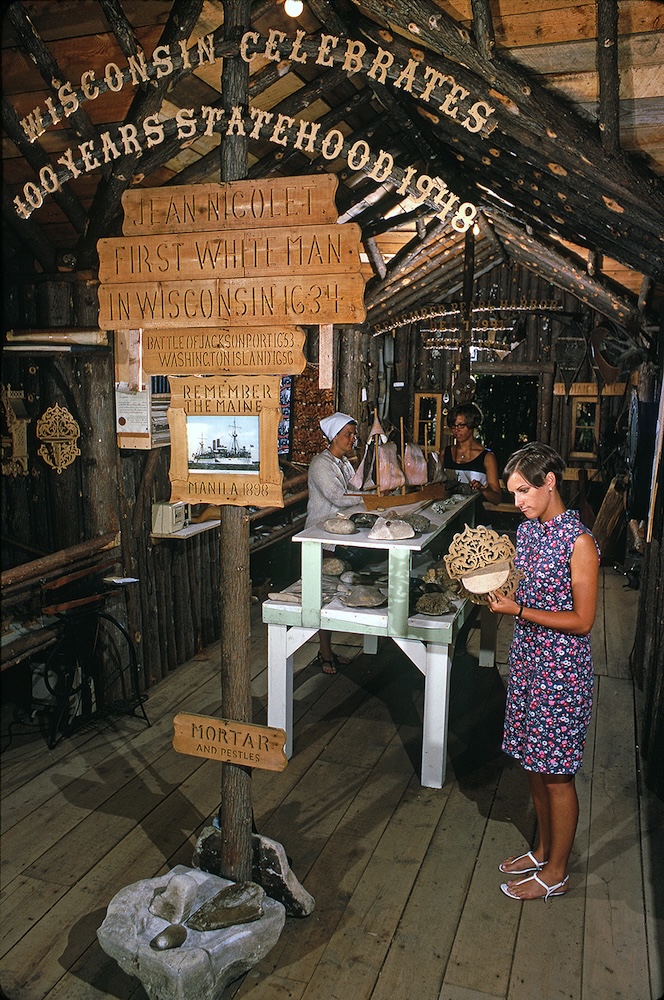
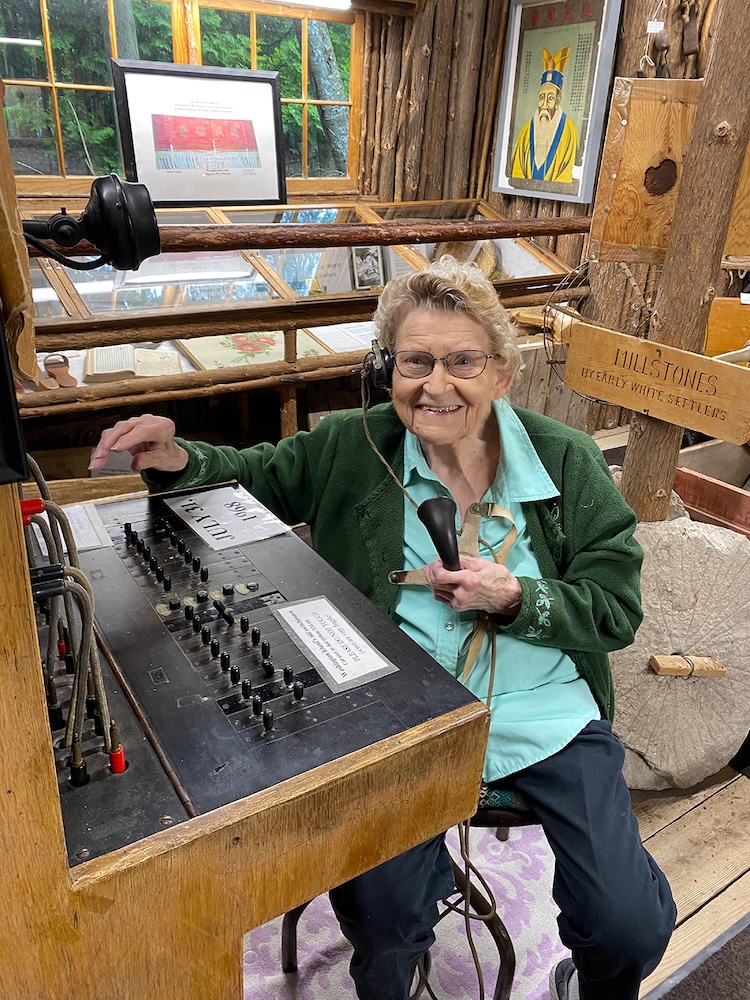
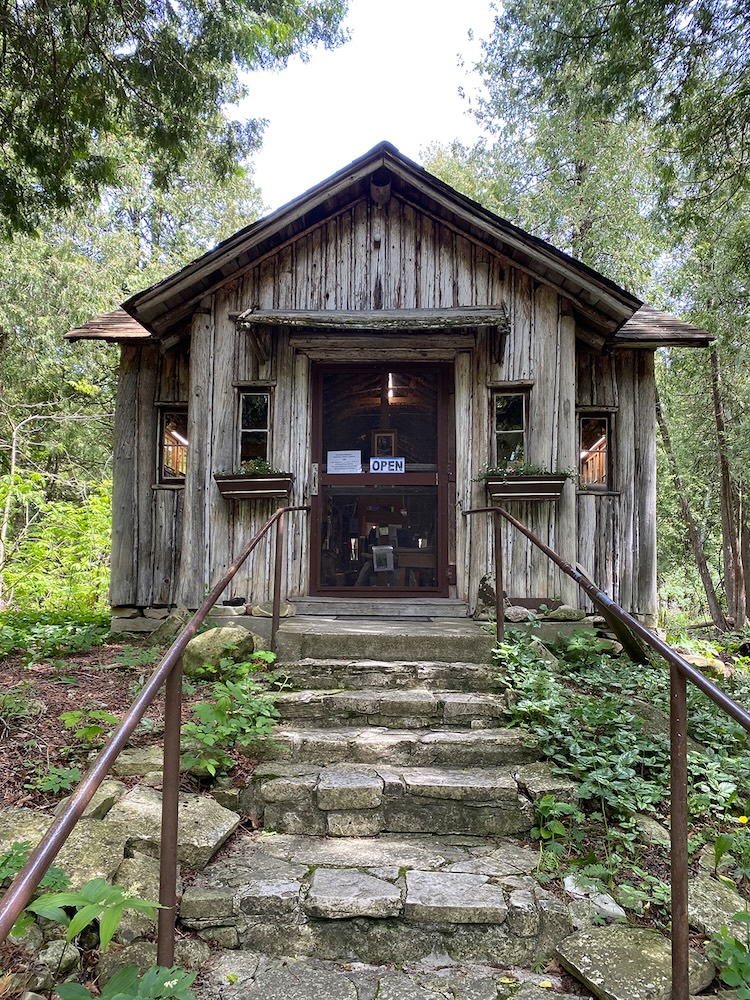
Founded by Jens Jacobsen, Jacobsens Museum on Washington Island opened in July 1931 and is understood to be the oldest museum in Door County. Like the Washington Island Archives and Jackson Harbor Maritime Museum, Jacobsens tells stories of the history and people of the Island.
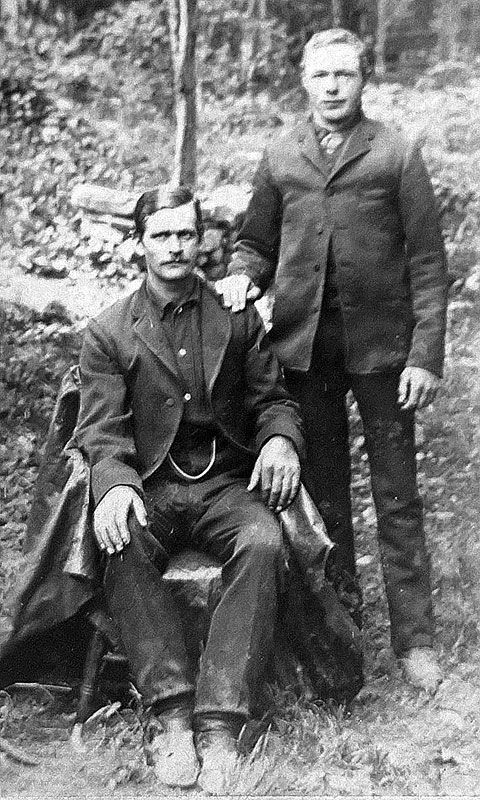
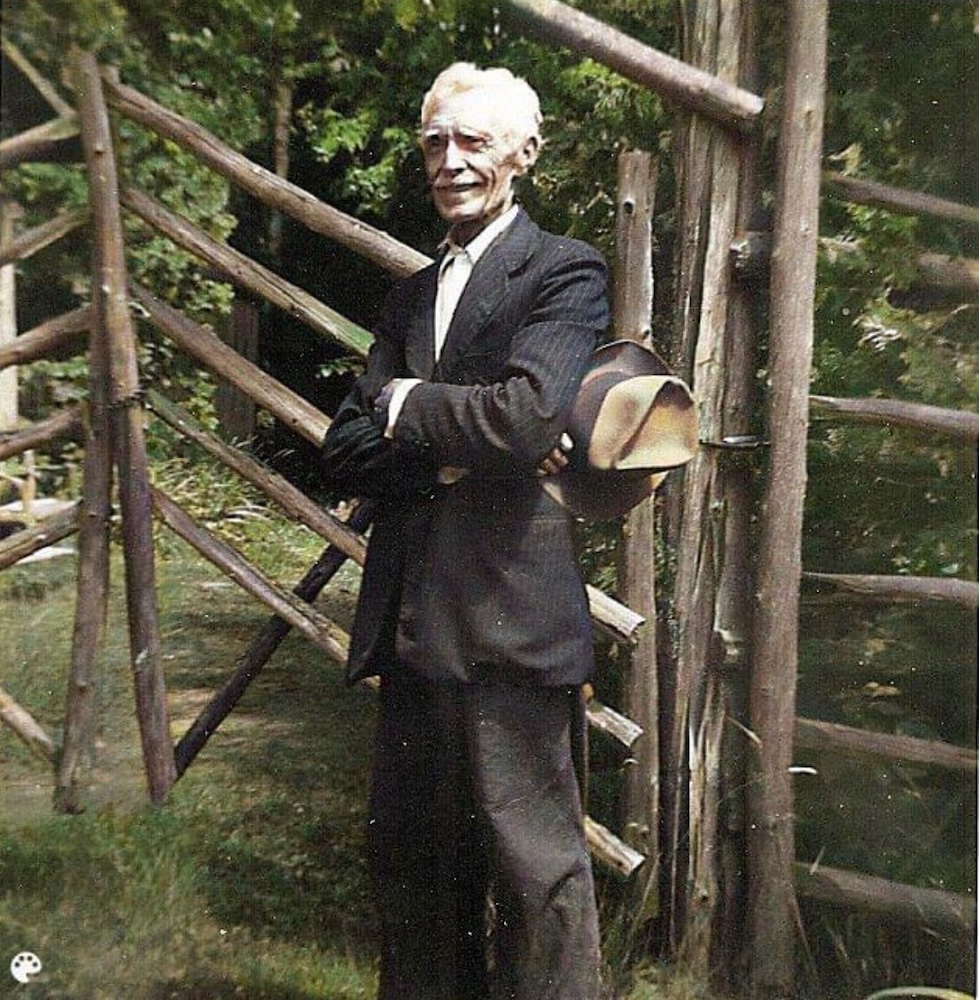
Jens Jacobsen did far more during his lifetime than build his museum beside Little Lake on Washington Island. Arriving on the Island in 1881 as a Danish immigrant of 14 years old knowing no English, he eventually became a potato farmer, an assessor, justice of the peace, town chairman, and school board member for many years. We believe he constructed as many as 14 vacation cottages. He raised four children single-handed after his wife of 14 years died. Just as importantly, Jens befriended generations of Island children.
One of those children that knew him well was Ruth Gau, who came to the Island every summer for most of her life and still owns the cabin built by Jens for her family. Her parents first visited in 1925. They found some acreage between Little Lake and Lake Michigan and bought it on the spot. Jens built their log cabin – using saw, ax and hammer – and named it “Balsam Lodge.” There was no well; water was hauled from the lake. Ruth and her brother Jim grew up with Jens as a neighbor. If they saw a light on in Jens’s cabin, they would walk over and borrow National Geographics from him (perhaps one of the issues now in the museum, dating back to 1934). Jens would often come to the Gau family’s cabin for dinner. “He told wonderful, wonderful stories. We would all be enthralled.”
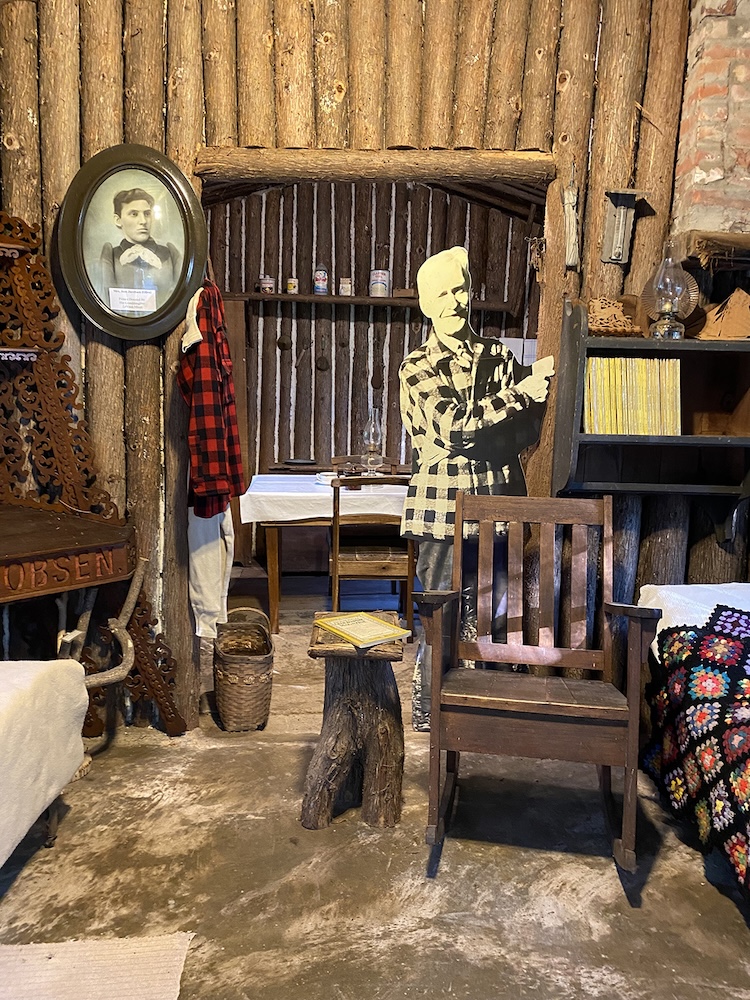
Ruth also remembered his many kindnesses: dropping off firewood and fresh flowers; sending cut Christmas trees to them in DeKalb, Ill.; opening the museum to late visitors after dark, lighting kerosene lanterns so they could see the collection. Jens was always making things: the Little Lake cottages, and then furniture to go in them; rowboats and oars, and a sailboat he named “The Flying Cloud” for people to use on Little Lake. “He lived very, very frugally,” Ruth said and recalled that he never complained about anything, and she never saw him in a bad mood. She said that every Christmas her family would gift Jens a plaid shirt, and there is still a photograph of Jens proudly wearing a shirt of that style in Jacobsens Museum today!
Daryl Justinger Johnson remembers first visiting Jacobsens Museum with her parents before there was an actual road to the museum – a road that first appears on a plat map of the Island believed to be from 1929! “Even now, when I open the door of the museum, I get a flash of feeling like a child all over again. It only lasts two or three seconds, but I still feel that childhood memory,” she said. “Mr. Jacobsen was always a happy man. He had that Danish accent and loved to tell children about the Indians. As children we wanted to hear about them. He helped children take an interest in them. He loved to demonstrate – how the Indians ground corn (with a stone mortar and pestle), how they skinned a deer. We would ride our bikes to the museum to hear his stories. He was a very special man.”
Jeannie Lindal Hutchins (1933-2024), who spent many years working at Jacobsens Museum as Director and a docent, remembered first visiting when she was 6 years old with her mother Agnes. Her first impression was of Jens, more than of the things in the museum. “I liked his accent,” she said. “It was easy to understand him. He joked that he had learned to speak ‘American.’ He had a gentle way about him. He had a nice way with kids.”
Jeannie remembers that she and Mary Jean McDonald would often ride their bikes from Swenson Road to the museum, and that Jens was always welcoming. “I loved it out there. All the kids liked him. He loved children. He was like a grandpa to all of us,” she remembered. This was especially poignant for Jeannie as her own grandfather, Rasmus Hansen, had already died.
All who remember Jens have one universal reminiscence in common: Jens as a storyteller. Ruth, Daryl, Jeannie, Bill Engstrom, and Jens’s grandchildren Dewey Jacobsen (1923-2021) and Mary Jacobsen Jorgensen all remember a particular story. When Jens decided that it was time for them to go home, he began telling the story of “The Goose that Laid the Golden Egg.” At the end of the story, he would reveal, hiding behind the museum door, a goose-shaped stone nestling a clutch of “golden eggs” made of painted pebbles. Then he would gently send the children on their way.
Surely, Jens Jacobsen would be pleased to know that, as adults, the children he befriended and nurtured still remembered him vividly and fondly, visiting the museum and looking into his compact cabin. Keeping memories of a kind, happy man who was happy to see them and always ready to share a story about his beloved Island home.
Even now, Jacobsens Museum displays many of the things that Jens made and collected: sailboat models, scrollwork, furniture, arrowheads, stone tools, fossils, and poetry. Allowing our visitors young and old to experience what has made this Island treasure so special since it opened in 1931.
-Howard Scott